Why Is Bollywood Struggling? Understanding the Business Model of OTT Platforms
Introduction: A Crisis in the Making
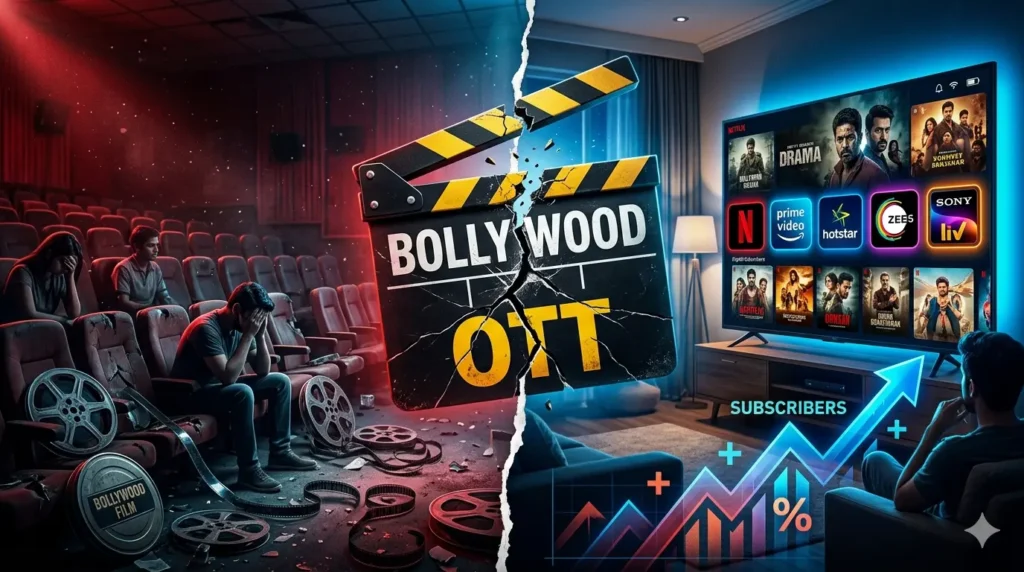
OTT Platforms have completely transformed the entertainment industry. While platforms like Netflix, Prime Video, and Disney+ Hotstar offer convenience and affordable entertainment, many experts believe they have significantly impacted Bollywood’s traditional business model.
But now, they have started rejecting films. Film producers are told to release the films in theatres first, after which the OTT Platforms would decide how much they’d be willing to pay for it. Film producers who made their films expecting a direct OTT release are now facing huge losses.
How did this come to be? What is the business model of the OTT Platforms? Let’s try to understand this.
Setting the Scene
A quick montage of voices from the industry sets up the topic:
“…is launching an OTT app, SRK+”
“I’ll be hosting Bigg Boss OTT on Voot”
“Why did Akshay Kumar’s film start flopping?”
“New movies, new shows every week”
“Just wait a few weeks, I’m coming to you all”
“That is the error, according to me, in the film industry’s role”
“The internet didn’t exist then, but it does now. The internet has boosted the availability, and rightly so”
These platforms are referred to as OTT — but what does that actually mean? Over The Top, in which sense?
What Does “OTT” Really Mean? A Look Back at Television in India
To understand this, we need to understand the history of television.
August , a new revolution swept through the television industry in our nation. It was the day when, for the first time, the Doordarshan (DD) channel was broadcast in colour. Television was introduced in India during the late s, but this point is considered to be the turning point in the Indian television industry — because DD was being broadcast in colour via the INSAT A satellite. (This satellite was also discussed in the piece on ISRO.)
Fast-forwarding a few decades, the next turning point was in , when the Indian government allowed DTH (Direct to Home) satellite television. With this, in, DishTV became the first DTH facility.
Before this, people watched Cable TV — cables were laid out, and you had to get them installed at your home for your TV to work. But satellite TV meant you could put up an antenna at home to receive satellite signals. You’d remember the dishes on balconies or rooftops, and to convert that signal, a set-top box had to be placed near your TV. Even today, many people use this.
With this, people had a much larger choice of channels they could watch at home — a large variety of channels were now being offered.
Fast-forwarding some more years, Web was introduced, and exponential growth was seen in social media websites. Along with them came the OTT Platforms.
The Netflix Story: From DVD Rentals to a Streaming Giant
was the year Netflix started getting into partnerships with Smart TVs and gaming consoles. But Netflix wasn’t a new company — in fact, Netflix predates Google. It was founded in by Reid Hastings and Marc Randolph. Initially, it was a platform on which people could rent movies via the internet.
“In today’s busy world, going to the video store is a hassle. With Netflix, you just make a list of movies that you want to see, and you’ll get your first DVDs in about business day.”
In , netflix.com was a website where, by making a monthly payment, you could get unlimited DVD rentals. You’d simply click on the DVDs of the films you wanted to watch, and the DVDs would be delivered to your home.
An interesting algorithm that is still used by Netflix began back in those days. In , Netflix started using the Recommendation System. Their system noted down the types of films people preferred based on certain demographics, and based on those choices, started recommending more films — for renting its DVDs.
Back then, Netflix’s competitor was Blockbuster. Blockbuster had physical stores where people could buy or rent CDs and DVDs. Netflix had the advantage of running the business online — people could order online and receive it right at their doorstep. On top of that, Netflix was a monthly subscription service: by paying monthly, one could rent unlimited DVDs.
By the time Blockbuster realised how great this business model was, they were already late. In , Blockbuster began their own online DVD rental similar to Netflix, but by , Netflix had million subscribers, while Blockbuster’s online service was at only million.
Netflix was always a few steps ahead in its innovation. By this point, Netflix understood that the business of selling or renting CDs and DVDs wasn’t going to last. Laptops and computers were playing CDs and DVDs then, but the speed at which technology was improving meant CDs and DVDs wouldn’t be able to keep up. The internet was improving unprecedentedly, and Netflix knew that in the future, people would prefer streaming films online instead of renting DVDs.
This is why, in , Netflix wanted to create a service that would allow people to go onto a website and stream films directly. A few years later, in , they made a deal with TV consoles, and in , they started dealing with big film production companies such as Sony, Paramount, and Disney — paying these production houses to buy their films so they could stream them on their platform.
July was, coincidentally, the same time that Netflix’s competitor Blockbuster filed for bankruptcy.
“Video rental chain Blockbuster has filed for Chapter Bankruptcy Protection.”
Not changing fast enough with the times caused up to $billion in losses for Blockbuster.
In , Netflix was valued at $ million. Today, Netflix’s valuation is believed to be more than $billion. To put that in perspective, you can compare it with Twitter — Twitter was bought for $billion, so Netflix is almost times as valuable as Twitter.
Around , Netflix realised that instead of relying on big production houses, they could save money by making their own films. This is why, in , Netflix launched its original TV series — House of Cards and Orange Is the New Black were among its first shows. They proved so successful that Netflix realised making original content was a huge advantage: they could satisfy all kinds of audiences on their own, in every genre, without waiting for external films.
Today, you can find more than ,000 original titles on Netflix, amounting to more than half of their content — % of Netflix’s content is original, and the rest is bought from production houses.
How OTT Platforms Arrived in India
If you compare the present with the era of cable TV and DTH, you’ll see a vast difference. Back then, we depended on middlemen — local cable TV distributors or set-top box companies. Today, you can watch films directly using the internet, right on a platform’s website.
Since these OTT Platforms reach viewers directly, they are known as Over The Top — they go over the top of the traditional middlemen.
In India, the first OTT Platform to launch was Reliance Entertainment’s Big Flix, in .
“Does your TV give you over of the latest blockbusters?”
But its model was a bit different — this was a Video on Demand service. When you wanted to watch a film, you had to select it and pay for it. This is also known as the Pay Per View business model.
The true growth of OTT Platforms in India happened after , when Zee launched Ditto TV, and SonyLIV was launched in . The shows you could watch on TV channels such as Sony, Star, Viacom, etc., were also being shown on Ditto TV.
Hotstar entered the market in today, it has been renamed Disney+ Hotstar. The next year, in January , Netflix entered the Indian market.
Coincidentally, in , another development changed this industry forever — no, not demonetisation. This was Reliance Jio.
“We will be able to provide an abundance of high-quality, high-speed data, and transform India from a high-priced data market to one with the lowest data rates anywhere in the world.”
With Jio’s entrance, data rates took a nosedive, gaining a large audience for these OTT Platforms. More people could access the internet and stream relatively cheaply on these platforms. This is why there are now more than OTT Platforms in India — and, obviously, they have been quite successful.
How OTT Platforms Build Their Content Libraries
So what is the business model of these OTT platforms? Let’s understand.
Basically, OTT Platforms have two ways of acquiring content:
1. Buying broadcasting rights — if a production house has produced a film, the platform can pay to buy its streaming rights and include it in their content library.
2. Self-production — producing films and web series themselves by investing their own funds.
This is how films and TV shows get to you on these platforms.
The Four Ways OTT Platforms Make Money
But how do they actually make money from this content? OTT Platforms basically have four models of monetization.
First — AVOD (Advertising-based Video on Demand). In this model, you can watch films and TV shows for free, but you’ll have to watch ads in the middle of the content. If there’s a large audience consuming content on a platform, companies can be charged to run ads. This is an entry-level model — OTT Platforms can use it to reach as large an audience as possible by offering free content. The biggest example of this model is YouTube. MX Player also used this model until recently, before adding their subscription option, MX Gold.
Second — SVOD (Subscription Video on Demand). If people want to watch something on the platform, they have to pay a subscription fee — normally monthly. Well-established platforms use this model, such as Netflix, Prime Video, and Disney+ Hotstar — because for platforms that aren’t popular, why would people pay for something they aren’t familiar with?
AVOD is more popular than SVOD overall — % of global OTT revenue comes from the AVOD model, and SVOD makes up about %. But if you look at per-user data, the SVOD model makes the most money.
Third — TVOD (Transactional Video on Demand), also known as Pay Per View. If you want to watch something, you pay a fixed fee for it. iTunes, Reliance’s Big Flix, and some films on Amazon Prime use this model. Last year, Salman Khan’s film Radhe was released on Zee using this model — similar to paying for a show in cinema halls, except here you pay just for the one film you want to watch at home.
Fourth — the Hybrid Model, where these three models are combined in various permutations:
- The most common combination is AVOD + SVOD — free content with ads, but you can pay for a subscription to remove the ads. YouTube is a good example (YouTube Premium removes ads), and Disney+ Hotstar and MX Player use this too. Netflix has relied on SVOD until now, but there have been recent discussions of Netflix introducing an ad-supported tier.
- The second combination is SVOD + TVOD — subscribers pay a monthly fee, but for the latest major films, they pay an extra fee on top. Zee and Amazon Prime Video do this.
But broadly speaking, there are only two ways these platforms generate income: from advertisers, and from the audience (when they pay the subscription fee). To get those subscriptions, though, platforms need a strong content library first — which is why so many of them want to create their own original films and shows.
A High-Stakes Gamble: Buying Film Rights
The business model of OTT Platforms is quite unpredictable. Which film rights should they buy? Which films should they invest in? And in return, how many people would subscribe to their platform? It’s really difficult to predict this relationship — no one knows which films will do well and which won’t, or which films will draw in the most subscribers.
These platforms have to take a lot of risks with their funds. When a film by a major actor is about to release, OTT Platforms pay in advance to buy the rights, since there’s a high chance the film will do well and draw in more subscribers. This is why, for films by certain big actors, OTT Platforms are ready to pay the big bucks.
For example, Kamal Haasan’s film Vikram — even before its release, this film had made ₹billion by selling its OTT and satellite rights. Or Shah Rukh Khan’s film Jawan — made on a budget of ₹billion, it’s said the makers already had a ₹billion deal with Netflix.
The Big Shift: Why OTT Platforms Now Wait for a Theatrical Release
In its nascent stage, OTT platforms had to pay premium prices to expand their content library and have quality content, so they’d become attractive to subscribers. But eventually, they realised that the large amounts of money spent buying film rights weren’t resulting in significant returns.
On top of that, when cinema halls reopened after the pandemic and films got back into theatres, OTT Platforms saw how even films with big names turned out to be flops % or % of Akshay Kumar’s recent films flopped terribly, despite him being a big name.
OTT Platforms realised it’s perhaps not a good idea to pay such high prices for films upfront. That’s why, today, most OTT Platforms wait for films to release in cinema halls first, and only buy the rights later, after judging the film’s success in theatres.
By doing this, OTT Platforms don’t have to spend on marketing — unlike a direct OTT release, where platforms like Netflix are responsible for marketing costs. Normally, marketing a film easily costs ₹–₹ million.
This is why the Indian film industry is going through an upheaval.
According to a Statista report, in FY, the average price of a PVR movie ticket in India was ₹. That’s excluding other expenses like popcorn or travel — just the cost of watching the film was ₹. Meanwhile, OTT Platforms give you access to an entire content library for a month at about half that cost — for most platforms, at least.
Initially, OTT platforms spent a lot of money building a good content library to attract audiences. Now they don’t have to spend as much to buy new films. This is very problematic for the film industry, especially for those who relied on earnings from cinema halls.
It’s true that some people still prefer going to cinema halls — especially for big-budget films with a lot of VFX. But the smaller films that people would casually watch at the cinema now draw in very little audience.
The Exception: Amazon Prime Video
For some OTT Platforms, this business is even easier — such as Amazon Prime Video. Amazon has claimed they don’t intend to make profits from Prime Video; it’s simply a bonus service within Amazon’s ecosystem.
“Because it’s the Prime Membership program, from a business point of view, we also like the business results — because it drives people to join Prime, and once they’ve joined Prime, they enjoy fast free shipping, so they also buy a lot of products from us. So it’s a vehicle to make fantastic content, and from a business point of view, it works for us as well.”
The main point is to get people to buy the Prime subscription, so that free deliveries on Amazon purchases drive up sales and become a source of revenue. Prime Video is simply an extra benefit thrown in for free — they aren’t looking to make a profit from it directly.
The Numbers Behind the OTT Boom
The next few years are expected to be huge for OTT Platforms. Deloitte published a report in February , “All About Screens,” estimating that the OTT market would see % growth each year, and that in the next decade, the market would be valued at ₹,000 billion.
Statista estimates there are million OTT users in India, with Disney+ Hotstar being the most subscribed and most-watched OTT Platform.
Looking at expenses, it’s estimated that last year OTT platforms invested $million buying films and creating original content — Disney+ Hotstar spent the most among them, at $million.
According to the same Deloitte report, each paying OTT customer subscribes to about platforms on average.
According to Statista, the average revenue per OTT user was around ₹in . This average is much higher for the SVOD model — each user accounts for ₹ on average from subscriptions, compared to ₹for the AVOD model and ₹for the TVOD model.
Even though revenue per user from the AVOD model is lower, Deloitte’s report shows that the AVOD model generates higher revenue overall.
Unfortunately, we don’t have more detailed data — these platforms don’t provide a breakdown of which films got the most views or which shows brought in the most subscribers. We can only estimate from afar. For instance, Netflix has claimed that Squid Game was its most popular show worldwide — so we can assume Netflix gained the highest number of subscribers around that show.
Conclusion
This has hopefully been an informative read. If you’d like to understand the Business Model of Bollywood itself — how the film industry makes money independently, and how its deals with cinema halls work for everyone involved — that’s covered in a related piece.
OTT Platforms have reshaped how audiences consume entertainment. While they provide convenience and affordability, they have also forced Bollywood to rethink its traditional revenue model. The future of the industry will likely depend on finding a balance between theatrical releases and digital streaming platforms
Thank you very much!
Editorial note: The original transcript had a number of figures, years, and statistics missing or stripped out during conversion (marked above with “”). These have been left as blanks rather than guessed at, so they can be filled back in from the original source.